

For decades, the scientific community believed that the human brain was a static organ—that once you reached adulthood, your “hard-wiring” was set in stone. However, the discovery of neuroplasticity has completely flipped the script. Neuroplasticity is the brain’s remarkable ability to reorganize itself by forming new neural connections throughout life. It means your brain is more like plasticine than a porcelain statue. But the real question for the modern, high-achieving individual is: Can we actually hack this process to learn complex skills, master new languages, or finish a year’s worth of research in a fraction of the time?
The answer lies in understanding synaptic plasticity and the chemical triggers that allow the brain to “unlock” its learning state. When you engage in deep focus, your brain releases a protein called Brain-Derived Neurotrophic Factor (BDNF), often referred to by neuroscientists as “Miracle-Gro for the brain.” While many students look for shortcuts to manage their heavy academic workloads, some choose to use a professional Essay writing Services like myassignmenthelp to analyze high-quality models of structural writing, which effectively provides the brain with a “roadmap” for complex logic. By seeing a perfectly executed example, your neural pathways can map the correct patterns much faster than by trial and error alone.
The Biological Engine of Learning
To understand how to “hack” your brain, you must first understand the hardware. Learning isn’t just a psychological act; it is a physical restructuring of your gray matter. When you learn something new, neurons—the brain’s communication cells—fire signals to one another. If you repeat that action, the connection strengthens.
This process is mediated by Myelin, a fatty substance that wraps around the axons of your neurons. Think of Myelin as the insulation on an electrical wire. The more you practice a specific skill, the thicker the myelin becomes, allowing electrical impulses to travel up to 100 times faster. This is why a professional pianist doesn’t have to “think” about the notes; their neural pathways have been “high-speeded” through myelination.
| Feature | Low Plasticity State | High Plasticity (Hacked) State |
| Primary Driver | Passive repetition | Active recall & BDNF priming |
| Neural Speed | Thin myelin (Slow signal) | Thick myelin (Rapid signal) |
| Focus Level | Fragmented (Multi-tasking) | Hyper-focused (Flow State) |
| Retention | Short-term (Cramming) | Long-term (Spaced Repetition) |
| Cognitive Load | Overloaded | Streamlined & Delegated |
The Science of “Unlearning”: Synaptic Pruning
Before you can learn faster, you have to understand how the brain clears out the “noise.” This process is called synaptic pruning. Think of your brain like a garden; if you don’t pull the weeds (old, unused information), the flowers (new skills) don’t have room to grow. To trigger this, you need to prioritize sleep architecture. During REM sleep, your brain actively decides which connections to strengthen and which to delete. If you are pulling all-nighters, you are essentially trying to build a skyscraper on a foundation of sand.
To optimize this “weeding” process, you must embrace the “80/20 Rule” of learning. Focus on the core 20% of the material that produces 80% of the results. When you reduce the cognitive load on your prefrontal cortex, you allow your “working memory” to function at its peak. For those applying for highly competitive academic programs, leveraging a scholarship essay writing service can be a strategic way to ensure their personal narrative is structured with the precision that admissions officers expect, allowing the student to focus their mental energy on mastering the actual subject matter of their future degree.
1. The “Feynman Technique” for Rapid Encoding
One of the most powerful neuroplasticity hacks is named after the Nobel Prize-winning physicist Richard Feynman. The hack is simple: if you can’t explain a concept to a 12-year-old, you don’t understand it yourself.
When you explain a topic out loud, your brain is forced to convert abstract thoughts into concrete language. This “active recall” strengthens the neural pathways much more effectively than passive reading. To practice this:
- Choose a concept: Write the name at the top of a blank sheet.
- Explain it simply: Pretend you are teaching a child. Avoid jargon.
- Identify Gaps: Where did you get stuck? Go back to the source material.
- Review and Simplify: Use analogies to make the complex simple.
2. Biological Priming: The BDNF Trigger
You can actually “prime” your brain for a study session using physical movement. Research shows that just 20 minutes of aerobic exercise significantly spikes your BDNF levels. This creates a “plasticity window” that lasts for about two hours.
During this window, your brain is hyper-receptive to new information. This is the best time to tackle your most difficult tasks—whether that’s learning a new coding language or drafting a complex thesis statement. Combine this with Omega-3 fatty acids and a “Dopamine Fast” (avoiding your phone for the first hour of the day) to ensure your brain’s reward system is calibrated for deep work rather than quick hits of social media validation.
3. Spaced Repetition and the Forgetting Curve
The human brain is designed to forget. The “Forgetting Curve,” discovered by Hermann Ebbinghaus, shows that we lose nearly 70% of what we learn within 24 hours unless we review it. Neuroplasticity hacks involve “gaming” this curve through spaced repetition.
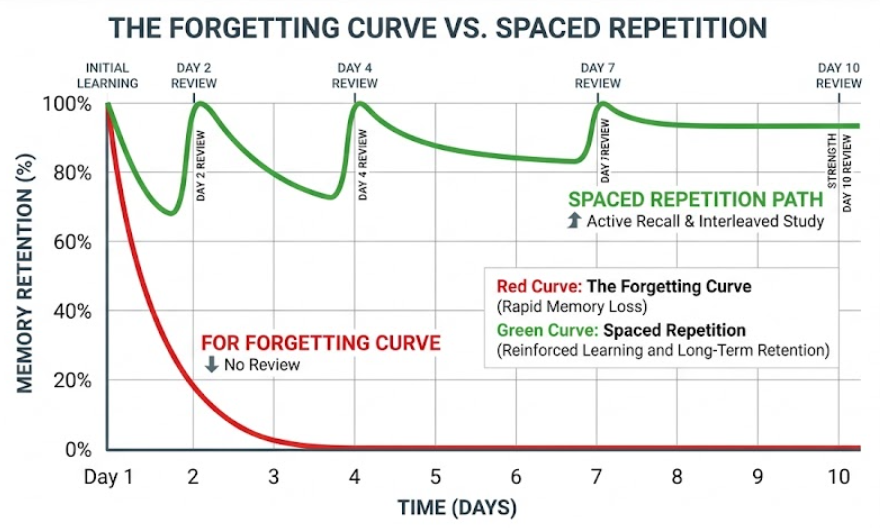
Instead of “cramming” for ten hours in one day, study for one hour over ten days. Each time you revisit the information just as you are about to forget it, your brain signals that this data is “high priority.” This moves the information from your short-term functional memory into your long-term cortical storage. Using tools like Anki or digital “Second Brain” systems helps automate this process, ensuring you are only reviewing what is necessary.
4. Environmental Design: The “Focus Cave”
Your environment is a silent architect of your brain’s plasticity. If you work in a cluttered space with constant notifications, your brain is practicing “distraction.” You are literally training your brain to lose focus.
To reverse this, build a “Focus Cave.” Use noise-canceling headphones, turn off all digital pings, and use a single-tasking approach. When you immerse yourself in one task for 90 minutes (an “Ultradian Rhythm”), your brain enters a state of “Flow.” In this state, the prefrontal cortex partially shuts down, allowing for effortless concentration and a massive spike in neural encoding.
5. Multi-Sensory Integration and Visual Anchors
The brain isn’t just a text processor; it’s a multimodal machine. To learn faster, engage multiple senses. If you are reading a text, try listening to the audiobook version simultaneously. Or, better yet, draw a flowchart of the concepts as you read them.
This creates multiple “hooks” in your brain for the same piece of information. If the “visual hook” fails, the “auditory hook” might catch. This is why data-driven visuals, such as process maps and Venn diagrams, are so effective in professional research. They allow the brain to see the relationship between variables instantly, rather than having to decode a wall of text.
The Power of Social Plasticity
We often think of learning as a solo endeavor, but the brain is a social organ. The “Protégé Effect” suggests that we learn better when we prepare to teach others. This triggers a higher level of cognitive processing and organization. If you are struggling with a complex assignment or a thesis, discussing it with a peer or a mentor can trigger new neural associations that you wouldn’t find alone.
Strategies for Long-Term Mental Agility
Neuroplasticity isn’t just about a single study session; it’s about a lifestyle of cognitive flexibility. To maintain a high-plasticity brain as you age, you must constantly introduce “Novelty.” Doing the same tasks every day creates deep, rigid neural ruts. To keep the brain “plastic,” you must challenge it with unfamiliar tasks—learn a new instrument, take a different route to work, or engage with high-level academic discourse outside of your primary field.
| Learning Phase | Recommended Hack | Expected Outcome |
| Acquisition | Multi-sensory input | Faster initial understanding |
| Consolidation | 20-min Nap / REM Sleep | Transfer to long-term memory |
| Retrieval | Active Recall (Testing) | Stronger neural pathways |
| Mastery | Teaching others | Deep conceptual integration |
The Future of the Plastic Brain
As we move further into 2026, the integration of AI-assisted learning and neurobiology will only deepen. We are entering an era where “how we learn” is more important than “what we know.” By leveraging neuroplasticity hacks—from biological priming and spaced repetition to strategic delegation of academic busy work—you aren’t just memorizing facts; you are literally upgrading your biological hardware.
Training your brain to learn faster is not a myth; it is a mechanical process of deliberate practice and physiological optimization. Whether you are a student, a professional, or a lifelong learner, the ability to reorganize your neural pathways is your greatest competitive advantage in a rapidly changing world. Stay curious, stay focused, and remember: your brain is always listening to the patterns you create. Make them count.
Frequently Asked Questions
What is the best time of day to study for maximum retention?
Research into circadian rhythms suggests that most people experience a cognitive peak in the mid-morning and a secondary recovery in the late afternoon. To leverage neuroplasticity, try to schedule your most challenging tasks during these “high-alert” windows and save repetitive work for your natural energy dips.
How does physical exercise actually help with learning?
Exercise increases the production of a protein called BDNF, which acts like a fertilizer for your brain cells. This protein helps repair damaged neurons, protects healthy ones, and encourages the growth of new synapses, creating a “plasticity window” that makes it much easier to absorb complex information.
Is multitasking bad for the brain’s ability to change?
Yes. When you multitask, you aren’t actually doing two things at once; your brain is rapidly switching between tasks. This constant switching prevents you from reaching a “Flow State,” increases cognitive fatigue, and weakens the neural pathways associated with deep focus and long-term memory.
Can you really “unlearn” a bad habit or incorrect information?
Through a process called synaptic pruning, the brain can weaken and eventually eliminate unused neural connections. By consciously stopping a habit and replacing it with a new, repeated action, you physically “starve” the old pathway and strengthen the new one, effectively rewiring your behavior over time.
About The Author
Mark Hales is a seasoned academic consultant and lead strategist at MyAssignmentHelp. With over a decade of experience in educational research and professional writing, Mark specializes in helping students navigate complex curricula and achieve their academic goals through structured, high-impact content.