In the bustling art scene of 2026, where digital noise often drowns out authentic voices, Shani Levni stands out as a quiet force. Born in Tel Aviv in 1990, this multidisciplinary Israeli artist, writer, and cultural thinker has carved a space where personal memory collides with collective trauma, and abstract beauty meets raw social justice. Her work doesn’t just hang on gallery walls—it sparks conversations about belonging, displacement, and resilience that feel urgently relevant to American audiences navigating immigration debates, mental health awareness, and cultural identity in a polarized nation.
Levni’s rise isn’t the overnight Instagram fame story we’ve heard a thousand times. It’s slower, more intentional—a journey built on sketchbooks, Berlin residencies, and a deep belief that art can heal what history breaks. For U.S. readers tired of performative activism, her story offers something genuine: an artist who turned personal questions of “Who am I?” into powerful community action.
Early Life: A Multicultural Foundation in Tel Aviv
Shani Levni was born on April 15, 1990, in Tel Aviv, Israel, a city pulsing with energy, history, and contradiction. Growing up in a culturally layered household—Jewish, Middle Eastern, and European influences blending in family stories of diaspora and displacement—she absorbed the weight of memory from a young age. Her grandmother, a visual storyteller, would sit with her for hours, turning faded photographs into living narratives. “Who am I?” and “Where do I belong?” weren’t abstract questions; they were dinner-table conversations.
This environment shaped Levni’s insatiable curiosity. While other kids played outside, she filled notebooks with drawings and questions about emotions, societies, and the human condition. Her parents encouraged this freedom, letting her experiment with paints, found objects, and small performances for friends. By her teens, Tel Aviv’s vibrant streets—Jaffa’s markets, the Mediterranean blues, the tension of history—had become her first canvas.
These early experiences planted the seeds for themes that would define her career: identity as fluid and multifaceted, memory as both burden and bridge, and art as a tool for connection rather than isolation. For American readers grappling with their own multicultural realities—from first-generation immigrants to those exploring hyphenated identities—Levni’s roots feel familiar and inspiring.
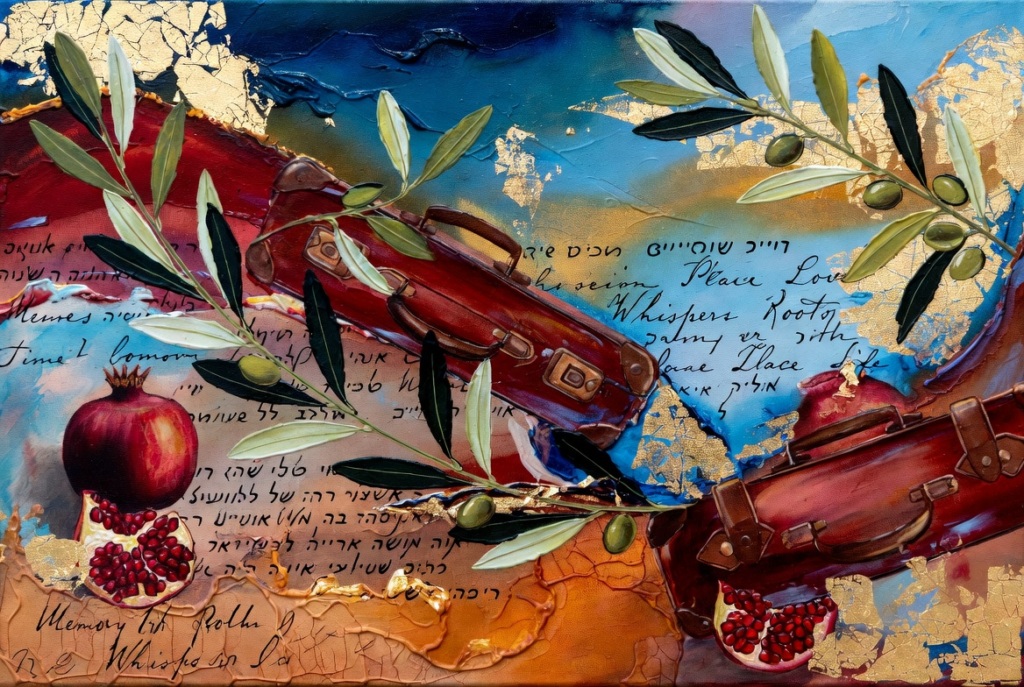
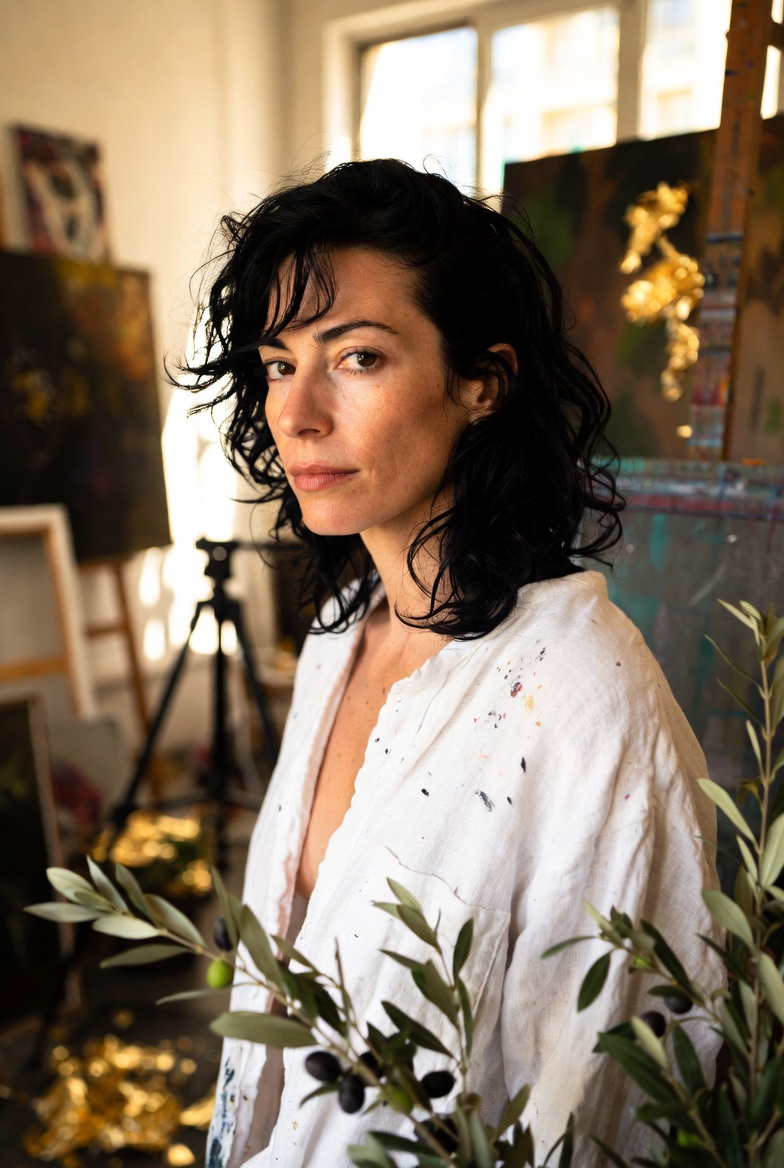
Shani Levni’s iconic mixed-media piece ‘Whispers of the Olive Tree’ (2018) exploring memory and diaspora.
Education: From Bezalel to Berlin – Building Intellectual Muscle
Levni’s formal training began at Jerusalem’s prestigious Bezalel Academy of Arts and Design, where she earned a BFA with a focus on abstract expressionism. She experimented boldly—translucent glazes over dense impasto, gold leaf symbolizing inheritance and divinity, negative space that breathed with tension. But she wasn’t content with technique alone.
She pursued an MFA in Art Theory in Berlin, writing a thesis titled Memory as Material. Here, she explored collective trauma through layered surfaces: thick paint for grief, delicate washes for recollection. Berlin’s own history of division and reconciliation deepened her understanding of how art can process pain on a societal scale.
This dual education—creative intuition plus critical theory—gave Levni a rare edge. She doesn’t just create; she thinks, writes, and speaks about why art matters. Her work refuses easy categorization, blending painting, performance, installation, and community practice. It’s the kind of intellectual-artistic fusion that resonates deeply in the U.S., where audiences value both emotional impact and thoughtful commentary.
Breaking Through: The 2016 Pivot and Signature Style
Levni entered the professional art world in 2016 through small community spaces, pop-up shows, and residencies in Tel Aviv and Berlin. Early reviewers praised her as a “painter, performer, and storyteller” whose work felt personal yet universally memorable.
Her signature style is pure hybrid magic: acrylics and oils layered over handwritten text, found objects, impasto contrasted with ethereal washes, gold leaf, and symbolic motifs like olive branches (resilience), pomegranates (abundance and fracture), ladders (ascent and escape), suitcases (migration), and maps (belonging). Mediterranean blues meet earthy reds. Negative space isn’t empty—it’s active, inviting viewers to fill in their own stories.
Key works illustrate this evolution:
- Whispers of the Olive Tree (2018, Tel Aviv Museum of Art): Mixed-media canvas fusing Hebrew letters with olive branches, speaking to rootedness amid displacement.
- Letters Never Sent (Jerusalem Biennale): Paper scrolls bearing handwritten voices of the displaced.
- Between Earth and Sky (2020, Rosenfeld Gallery): A solo show exploring earthly pigments and heavenly washes.
- The Weight of Light (2025, Berlin): Large-scale pieces on generational memory, now in collections at the Jewish Museum Berlin and Tel Aviv University.


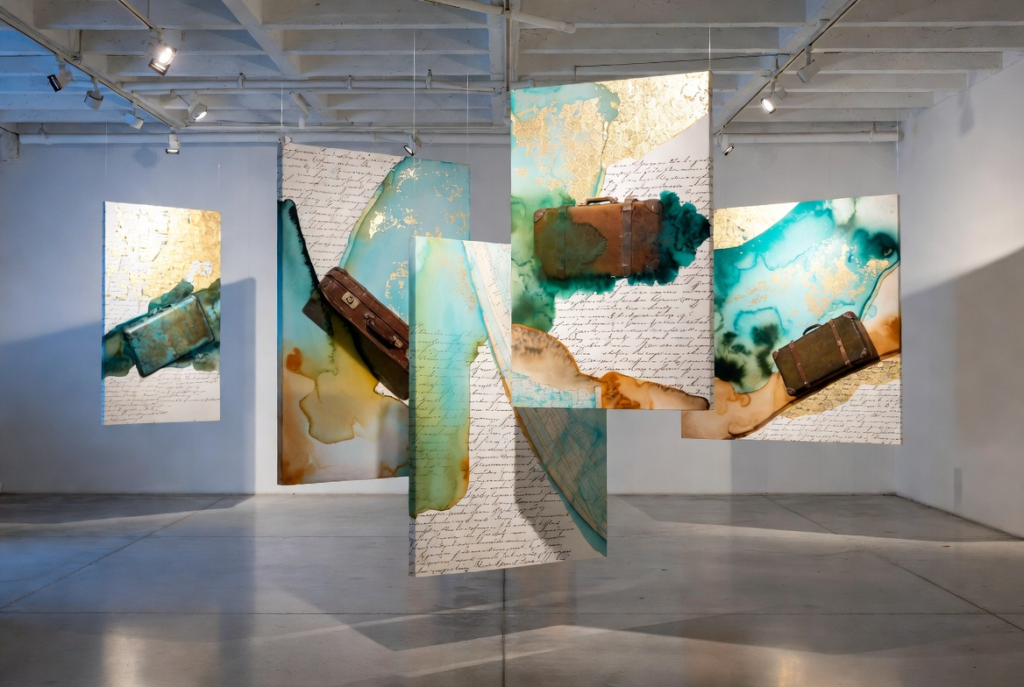
Installation view of Shani Levni’s ‘Between Earth and Sky’ (2020) at Rosenfeld Gallery.
The Root Collective: Where Art Becomes Activism
In 2023, Levni founded The Root Collective, a nonprofit based in Jaffa that has since expanded across five countries. Through 28 documented workshops, it has reached over 600 refugee and immigrant youth. Participants use recycled materials to create murals and installations, reclaiming their narratives and building confidence.
This isn’t side-project charity—it’s core to Levni’s practice. She sees art as relational: a dialogue that heals, connects, and challenges. For U.S. readers concerned with mental health, immigrant rights, and youth empowerment, The Root Collective feels like a blueprint. In an era of performative social media activism, Levni’s hands-on model shows what real impact looks like. She’s spoken at TEDx Jaffa, UNESCO panels, and the Berlin Biennale Symposium, proving art can move from studio to street to policy conversation.
Digital Breakthrough: Instagram as Launchpad
Levni’s Instagram (@shanilevni0011) became her secret weapon. By sharing her creative process transparently—sketchbook pages, studio experiments, workshop moments—she bypassed traditional gatekeepers. Strategic hashtags and authentic storytelling turned followers into a global community, leading to fashion collaborations, gallery partnerships, and wider recognition.
In 2026, this digital-to-physical journey feels especially powerful for American creators. Levni proves you don’t need a famous mentor or big-city break—you need consistency, vulnerability, and a message that matters.
Challenges, Resilience, and What’s Next
Of course, the path wasn’t smooth. Funding struggles, skepticism toward her hybrid practice, cultural barriers in Europe, and the emotional weight of heavy themes tested her. Levni responded with therapy, journaling, and relentless authenticity—refining her voice while keeping the raw tension alive.
Looking ahead: a 2025 Berlin solo show, a documentary on community art’s healing power, her first memoir, and Root Collective expansion with sustainable, eco-friendly programs. She’s writing, speaking, and creating with the same fire that started in those childhood notebooks.
Why Shani Levni Matters to America in 2026
In a divided United States, where conversations about identity, immigration, and belonging dominate headlines, Levni’s work offers hope without naivety. She reminds us that memory isn’t just history—it’s material we can reshape. Her art doesn’t preach; it invites. It doesn’t divide; it connects.
For emerging artists, activists, and anyone questioning their place in the world, Shani Levni is proof that creativity plus courage can create real change. She’s not just making art—she’s building movements, one layered canvas and one empowered young voice at a time.
As we move through 2026, keep an eye on Shani Levni. Whether in a Berlin gallery, a Jaffa workshop, or your Instagram feed, her message is clear: art that lingers, provokes, and heals is the kind worth creating—and the kind worth seeing